
The New River Valley is blessed with incredible fishing opportunities and getting active with our Chapter is one of the best ways to meet passionate anglers eager to share their knowledge on where to go, how to improve your skills and what to use to find success fishing the rivers and streams we work together to restore.
The Virginia Department of Wildlife Resources (DWR) recognizes the following trout fishing opportunities in the Commonwealth:
- Wild Trout Streams
- Stocked Trout Lakes
- Stocked Trout Streams
- All of these locations can be seen on this ArcGIS Map
For more information, see the following DWR web pages:
- Trout Fishing Guide https://dwr.virginia.gov/fishing/trout/
- Designated Stocked Trout Waters https://dwr.virginia.gov/fishing/trout/catchable-trout-stocking-program/
- Wild Trout Management Plan https://dwr.virginia.gov/fishing/trout/wild-trout-management-plan/
Local Waters
Listed below are some of our best local and nearby waters with information on the fishing opportunities all around the area. Always be sure to check the state fishing regulations (DWR Trout Fishing Guide) and never hesitate to attend a New River Chapter event to meet people who can answer your questions.
The “home waters” of New River Trout Unlimited include a number of excellent, stocked trout streams, including the following (in no particular order):
- Giles County: Big Stony Creek, Little Stony Creek, Wolf Creek, Dismal Creek
- Montgomery County: Poverty Creek, Toms Creek, Craig Creek
- Floyd County: Goose Creek, Little Indian Creek, Little River, Rush Fork, Burks Fork, Laurel Fork
- Pulaski County: Peak Creek
In addition, DWR identifies many miles of area waters as “Wild Trout Streams.” According to the DWR website, “there are more than 3,500 miles of coldwater streams that contain wild trout populations in Virginia. Wild trout are an indicator of healthy watersheds and contribute to our quality of life.” While these streams do not receive regular stockings of hatchery-reared trout, they are recognized as capable of holding self-sustaining populations of brook, rainbow, and brown trout (species vary from stream-to-stream).
Big Stony
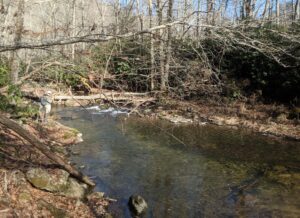
The Big Stony is one of our region’s best trout streams, renowned for its regular trout stocking schedule! Best of all, the decades of restoration work by NRTU to restore the Big Stone habitat and improve its health through trail maintenance and stream cleanups has helped make it even better. Some of the most popular sections to fish are the National Forest section along Big Stony Creek Road from Pearisburg. Some of the best fishing on Big Stony takes place from fall to spring when the waters are stocked by the DWR. Fishing is open year round but stocking happens in the fall and early spring. Along with a Virginia fishing license you must also have a trout license and a National Forest stamp to fish stocked waters.
New River
Though the New River is not a trout stream, it is the largest and most impressive waterway in the New River Valley and our chapter of Trout Unlimited bears its name! Our local section of this river runs from Claytor Lake into West Virginia. A variety of rare and specialized fish species can be found in the NEW, including the colorful endangered Candy Darter. Our chapter members regularly visit these waters with our heavier weight fly rods to accommodate the fighting Smallmouth, Walleye, Muskie, Crappie, Bluegill, Carp, Channel Catfish and Flatheads. For many years the NRTU chapter has participated in the Renew the New cleanup event in Radford. Local guides accommodate fly fishing from small boats using elaborate custom-tied Clouser Minnows or articulated patterns such as Chocklett’s Gamechanger. Our fly-tying skills really get a workout on the New! Be careful and bring your tape measure when fishing for bass, as the size limits in the regulations are tricky. Muddler Minnows are a favorite lure for these bass. Be mindful of special weather events that cause occasional water releases from the dam. Access to the New is available through the park systems near Radford University or country backroads. The local history tied to the New includes the story of Mary Draper Ingles who was captured and carried by the Shawnee into Ohio, escaped, and found her way home over 500 miles by following the river.